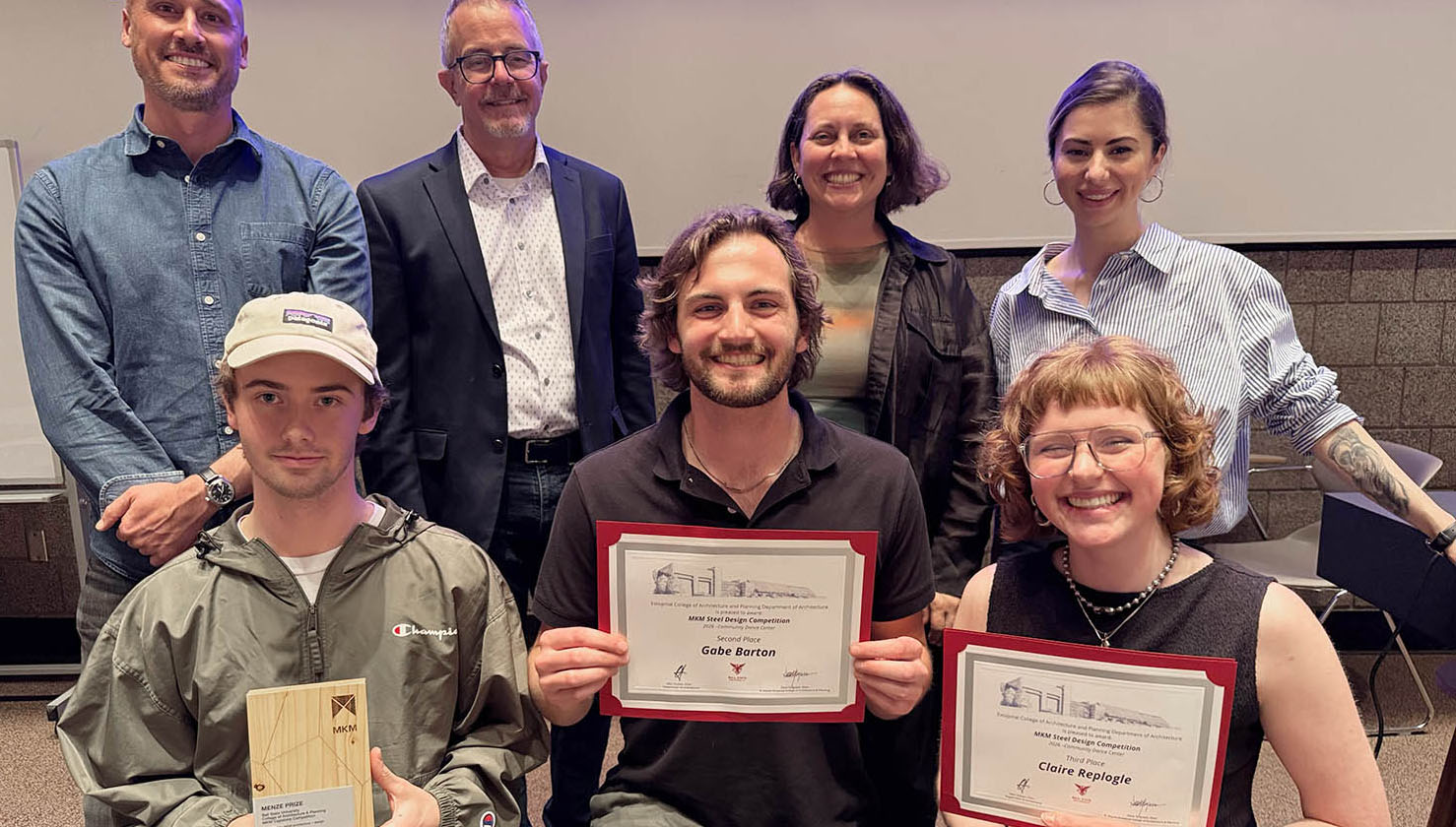
Meet the three Ball State architecture students who won the 2026 MKM Steel Competition. Explore their award-winning steel design projects and what made them stand out.
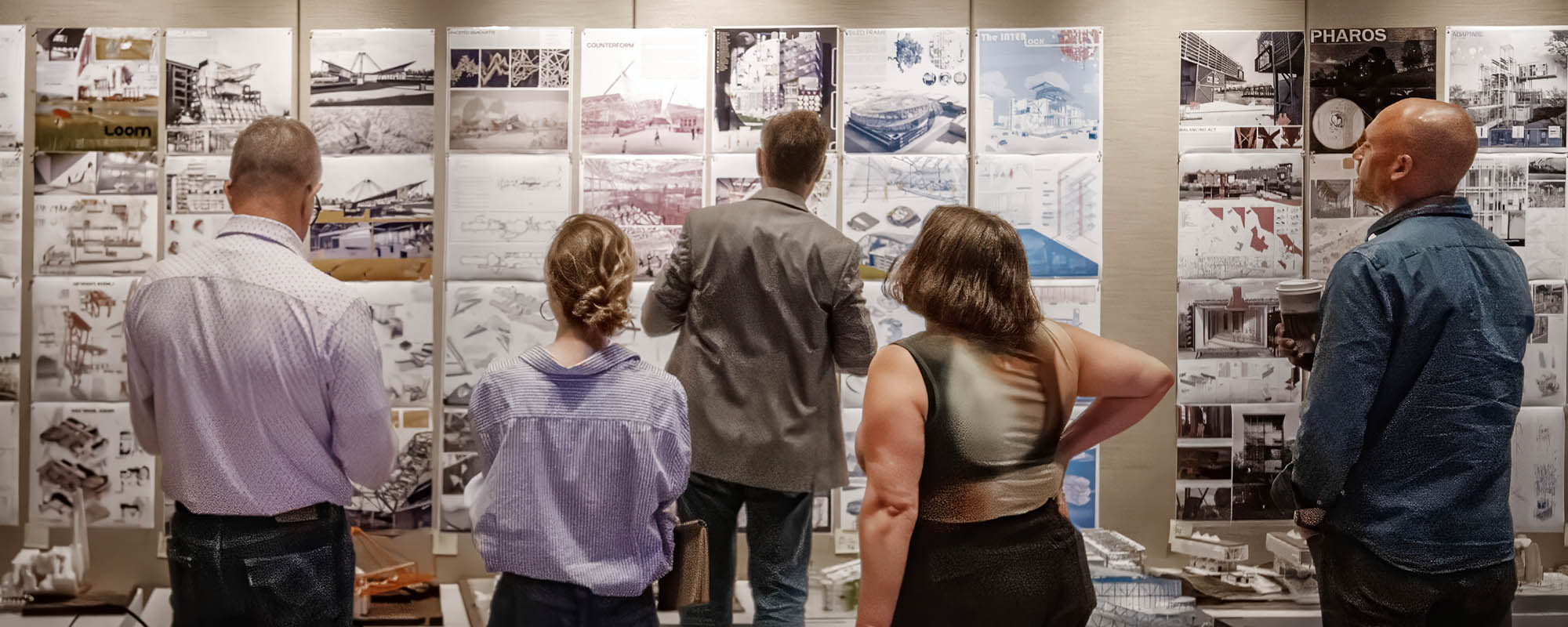
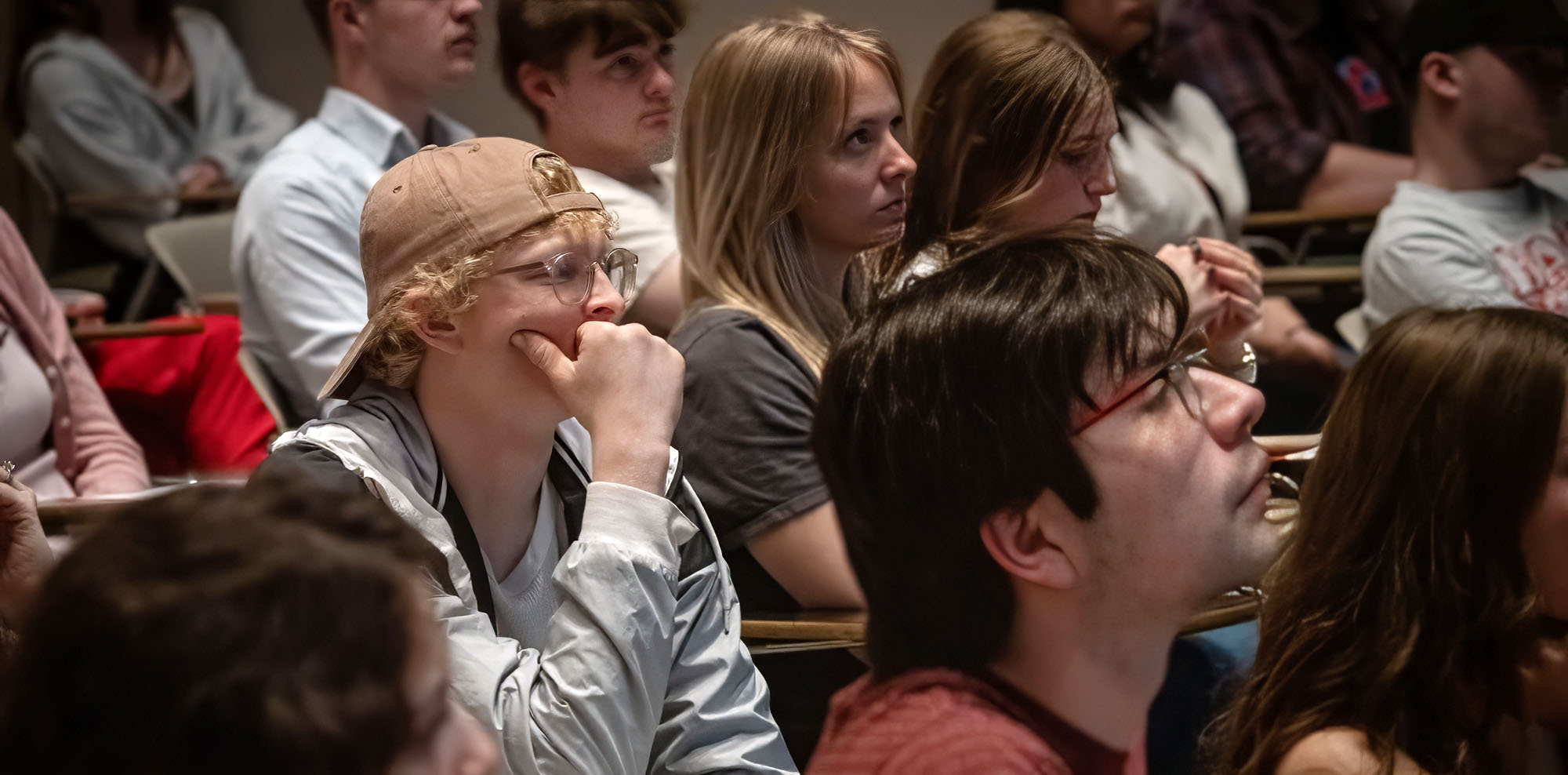
It’s a Friday afternoon during the last week of classes. Most students have already mentally checked out for the semester, but the lecture hall in Ball State’s College of Architecture and Planning building is packed. Students fill the seats, line the walls, crowd the doorway. Their work surrounds them: 21 architectural projects taped to the walls, models positioned on the floor in front of them, the physical evidence of an entire semester compressed into visual narratives.
There’s an energy to the room. Relief. Pride. Anticipation. They’re done. After months of work, after long nights and early mornings, after revisions and critiques and moments of doubt, they’re actually done. Their projects are on the walls. They’re here for the MKM Steel Competition awards, an honored tradition in a program built on honors and traditions.
Junior Gabe Barton is one of these students feeling that relief. That sense of having just endured something epic. Something that consumed him for months and now stands taped to the wall, literally at the finish line. When his project was finally finished and submitted the week before, he went home and slept for 16 hours. Then he woke up, went to classes, took a seven-hour nap, woke up, ate dinner, and slept for 12 hours.
“That was my recovery process,” he says, the relief clear on his face that the end had come.
What’s at Stake
The project that consumed Barton for the past three months was part of the MKM Steel Competition, which has been pushing Ball State architecture students beyond classroom assignments for 33 years. Each year, most third-year students across eight different studios take on design challenges. Faculty either use the project statement created by the ACSA Steel Competition or create their own challenge in the ACSA “open” category. Some give students firm parameters, others offer more freedom, but the goal is to explore steel’s structural and expressive potential while addressing real architectural and community problems for students to solve.
In each studio, outside professionals judged student work and selected the top three projects. Those 21 finalists advanced to today’s final jury.
The competition awards scholarship funding and cash prizes. The top prize is the Menze Prize, named for MKM founding partner Ron Menze. Second and third place awards follow. The top three winning projects will be displayed in the CAP building.
But MKM architecture + design doesn’t sponsor this competition just to write checks. The firm has deep roots at Ball State. All five MKM principals are Ball State College of Architecture and Planning graduates, and the majority of the firm’s team are alumni. They remember what it felt like to be students. They wanted to create something that pushes students to take real creative risks, to explore architecture as an art form while solving real-world problems and being aware of the actual needs they’re addressing.
Why It Exists
Ron Menze graduated from Ball State in 1979. Fourteen years later, he and his partners at what would become MKM architecture + design decided to give back to the college that shaped them.
“We said we should pool our money and start something here at the college. We can’t take the money away. It’s permanently endowed to Ball State and the College of Architecture and Planning. So it grows each and every year and gets bigger and bigger for the students.”
— Ron Menze
They started in 1993. Small at first: $500 in prize money, Saturday morning sketch problems on 2×2 pieces of cardboard. But they kept at it. Year after year. They grew the fund and endowed the money through the Ball State Foundation and the Community Foundation in Fort Wayne.
When Menze retired in 2017, MKM surprised him with an announcement: The top prize would be renamed the Menze Prize.
Even in retirement, Menze still comes back when he can. Over the years, he’s made the drive to Muncie to sit in on the judging, listen to the comments, make his own notes and thoughts on the students’ work, and introduce himself to the winning students afterward. You can see how proud he is of the 33-year tradition, one that started with $500 and cardboard sketches and has grown into a permanent endowment.
Why Story Beat Spectacle This Year
Before the students filed into the lecture hall, four jurors spent the day moving between the 21 finalist projects. Looking at details, thinking things through, talking about each project together.
The jury included **Dodd Kattman** (’86), a founding principal of MKM representing the firm’s annual judging slot; **Catherine Wilmes** (’13), an assistant professor from Illinois Institute of Technology; **Elise DeChard**, founder of Detroit-based END Studio and co-head of the Architecture Department at Cranbrook Academy of Art; and **Sam Vonderau** (’08), partner and design principal at DELV Design in Indianapolis.
The judges were looking for different things, bringing different perspectives. That’s the point. But they all started noticing something the projects that rose to the top had in common: **story over style.** It’s the first year AI-generated imagery has been truly accessible to students. The first year they could theoretically pump out photorealistic renderings with a few prompts. Students could have leaned into that capability. Instead, they focused on ideas. On how buildings are actually assembled. On telling stories about people and places rather than making things look cool.
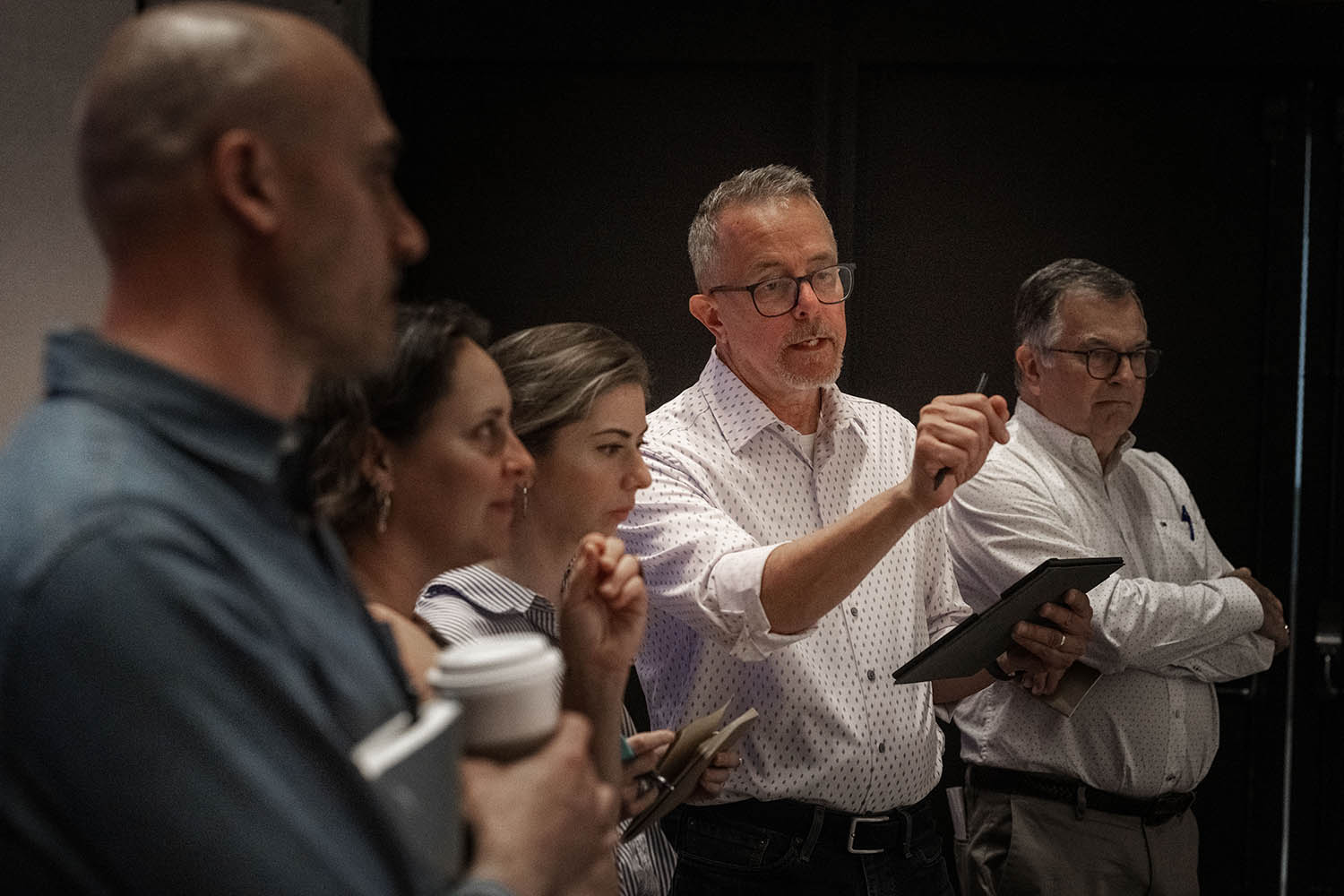
“After looking at all these wonderful projects, I was really impressed. I feel like super graphics, realistic graphics you can create instantly on your phone with a very simple prompt. What we saw in these projects wasn’t people going all in on super graphics, but your ideas and your personalities were coming out.”
— Dodd Kattman, MKM Principal, ’86
“After looking at all these wonderful projects, I was really impressed,” Kattman tells the room during the ceremony. “I feel like super graphics, realistic graphics you can create instantly on your phone with a very simple prompt. What we saw in these projects wasn’t people going all in on super graphics, but your ideas and your personalities were coming out.”
“The projects that really stood out to me are the ones where the narrative through line is very clear. As an architect and as an educator, I think that storytelling is one of the key things that we do in the profession. Whether it’s the story of how someone inhabits the spaces that we’re designing or telling narratives about cultures or about places, storytelling is really key to architecture,” DeChard said, agreeing with the others.
Wilmes was impressed by the advanced thinking she saw from third-year students. “A clear thesis, a clear idea or entry into the way they’re thinking about how the project is developed,” she notes. “Some of these winners are ahead of where students were ten years ago.” Wilmes competed in this competition as a Ball State student more than a decade ago and remembers what it was like: how tough the project is, how demanding the competition.
The jurors noticed students choosing substance over spectacle. And they rewarded it.
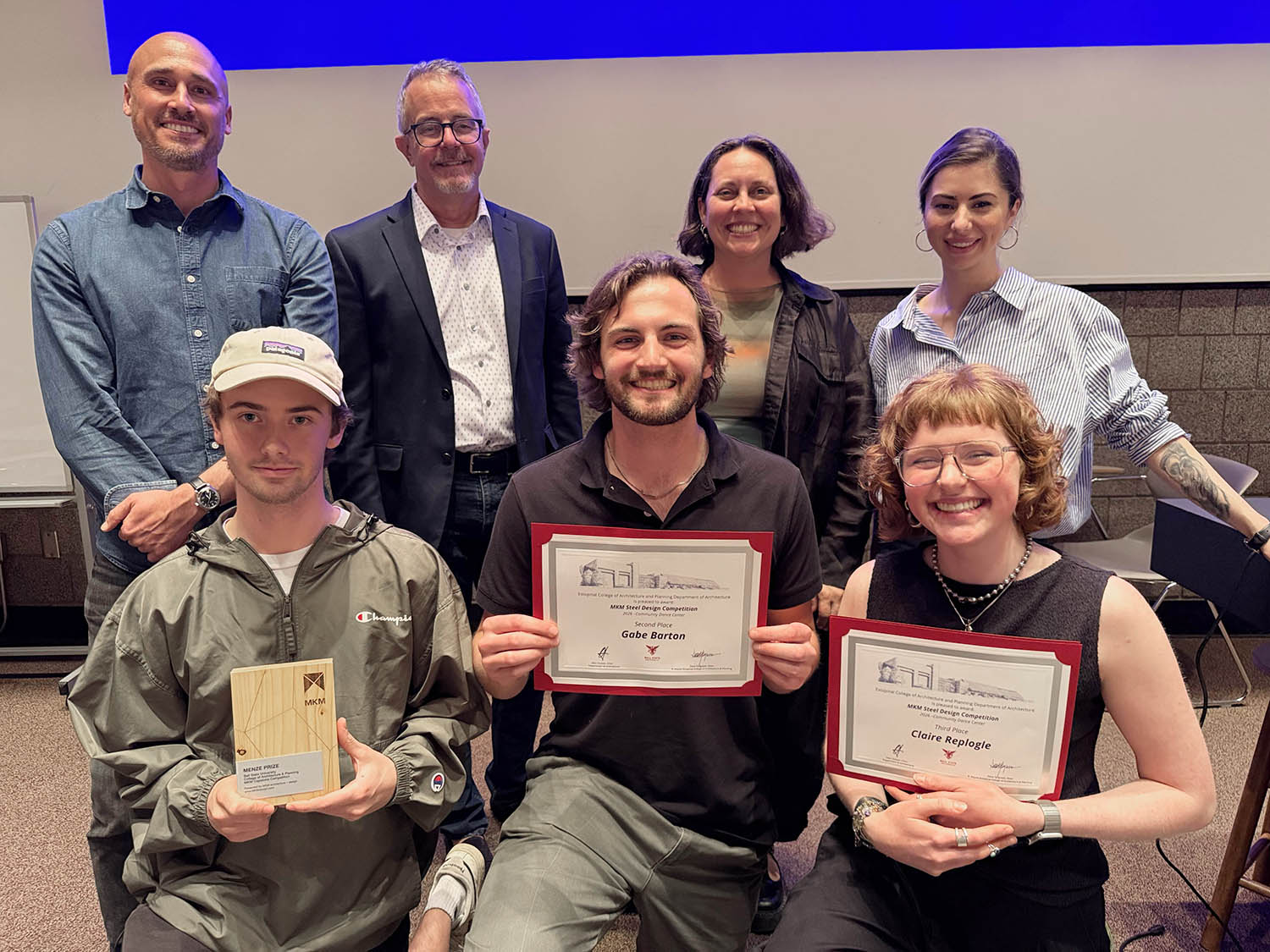
2026 MKM Steel Competition winners with judges. Front row (L-R): Aiden Henning (First Place/Menze Prize, “Balancing Act”), Gabe Barton (Second Place, “Reclaimed” — Fisher Body Plant 21 Rehabilitation), Claire Replogle (Third Place, “Public Parking” — Parking Garage Transformation). Back row (L-R): Sam Vonderau (’08, DELV Design), Dodd Kattman (’86, MKM architecture + design), Elise DeChard (END Studio, Cranbrook Academy of Art), Catherine Wilmes (’13, Illinois Institute of Technology).
The Winners
The room goes quiet as the award ceremony begins. The judges talk about what they saw, what stood out, and what students can take from it all. They emphasize how projects like these really help build portfolios and show students the importance of being able to solve problems and bring ideas to life.
After the ceremony, students gather around their projects for photos. Winners hold their certificates, standing with professors in front of the boards and models that represent months of work. Cameras click. Handshakes and congratulations make their way around the room.
Barton, a week removed from his 16-hour sleep recovery, is glad it’s over but pretty happy with how it all turned out. He won second place for his reimagined Fisher Body Plant in Detroit, a project that transforms building deconstruction into a circular economy.
All those sleepless nights. All that work. It paid off. But look around the room and you see it on other faces too. Even the students who didn’t win carry that same look. Pride in what they built. Relief that it’s done.
The boards come down. The models get carefully packed. Students file out of the lecture hall, some heading straight to celebrate, others probably heading straight to bed.
For 33 years, projects from this competition have launched careers, filled portfolios, and opened doors. The work remains in photographs and presentations, but the real legacy is what students take with them: the knowledge that they can push themselves further than they thought possible, that they can solve complex problems, and that their ideas can hold up under scrutiny. That’s what keeps bringing Menze back when he can. That’s what drew Kattman, Vonderau, and Wilmes back to judge. That’s what keeps the endowment growing. And that’s what makes this more than just another assignment.