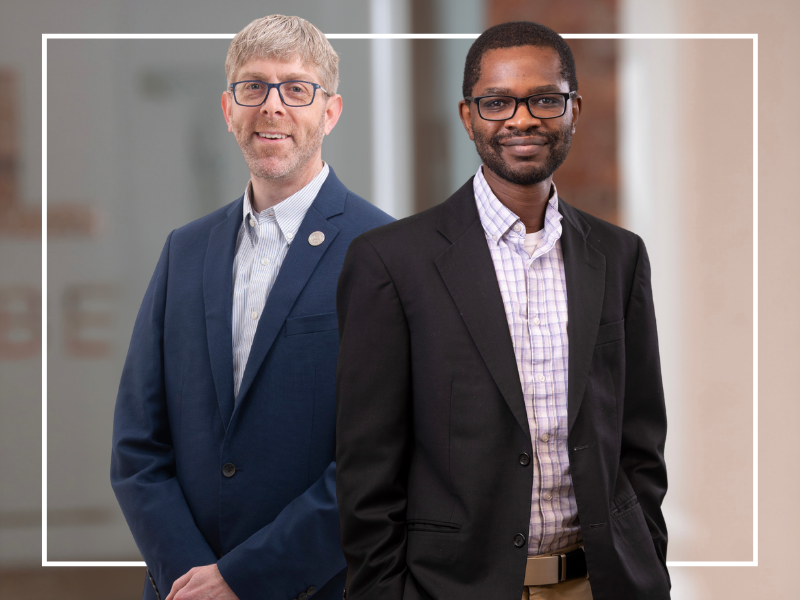
MKM announces the promotion of Associates Tafadzwa and Jonah Garoutte to Senior Associate Roles, recognizing their contributions to the firm.

In the book, “How Buildings Learn”¹, Stewart Brand challenges the assumption that a building is complete when construction ends. He argues that design continues as occupants, technologies, and communities change.
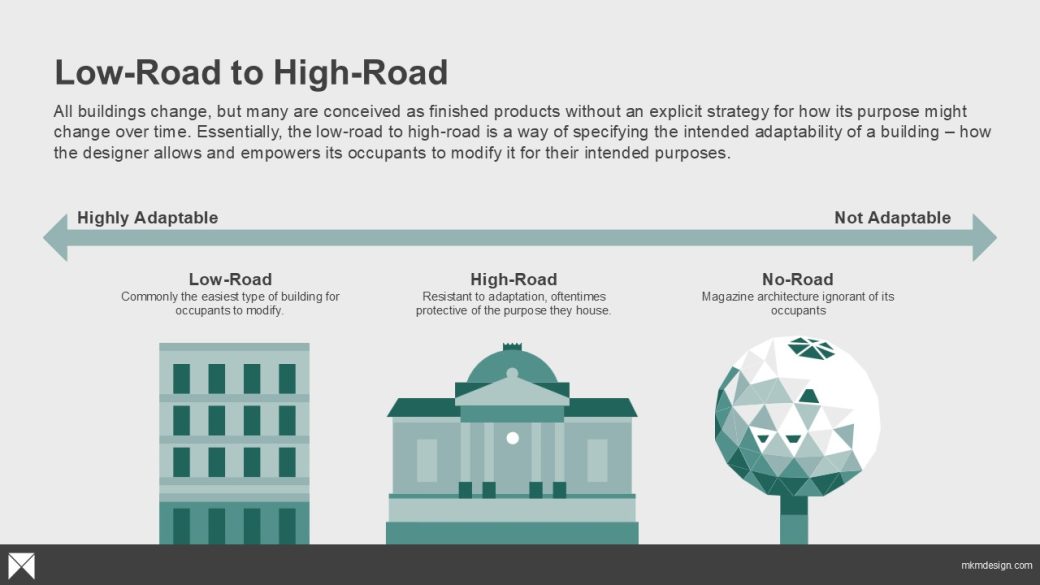
The “low-road to high-road” concept describes how much a building allows users to participate in that evolution, framing adaptability as an intentional decision: How readily can people alter a building to support purposes the original designer may not have anticipated? A low-road building is not necessarily better than a high-road building, and a high-road building is not always better than a low-road building. What matters is when a building’s design does not consider its users and their ability to have a building that changes alongside them. This leads to no road at all.
The Low Road
A low-road building is relatively easy for occupants to modify. It may be plain, robust, loosely planned, and, traditionally, constructed with vernacular materials. Its value lies less in preserving a fixed architectural image than in its ability to evolve with its occupants. This does not mean it is not aesthetically pleasing. A warehouse converted into studios, a former retail space adapted for community services, or a reconfigured office floorplate operates as a low-road environments. They preserve their functional value for as long as their structure and skin allow.
Such buildings give users practical agency. They can revise layouts, introduce new technology, add storage, repaint, and reinterpret rooms without requiring a capital project or professional intervention at every step. The building works for the people.
The High Road
A high-road building, by contrast, is designed around a more specific, protected, or highly controlled purpose. It may be durable and particularly ornate, but its structure, systems, image, or cultural significance can resist adaptation.
A courthouse, museum, or historic civic building is much less likely to be adapted for purposes different from those for which it was conceived. High-road does not mean inflexible design, but it does prompt a person to question carefully before making alterations to it. In many cases, this resistance to casual alteration is appropriate: a building may protect a civic institution, a collection, a clinical environment, or a preserved historical significance.
Such buildings help users protect collective values and purposes through a brick-and-mortar establishment. Though even a high-road building will inevitably change with age, the building carries a significance that people cannot help but feel protective of.
The No-Road: Magazine Architecture
And then there is the no-road condition. Architecture preoccupied with a singular visual concept communicates to occupants that they have little to no ability to alter it. Highly customized components, inaccessible systems, irregular geometry, and awkward layouts make even minor changes implausible. This is a building that photographs well for awards but is not built to accommodate life. When the building’s purpose changes — if there was ever a clear purpose to begin with — occupants must work around the building rather than allowing it to support them because of its prioritized “artfulness.”
The low-road-to-high-road framework is especially useful when paired with Brand’s related concept of “Shearing Layers.” In this model, a building is not a single unified object but a collection of layers that change at different rates: stuff, space plan, services, skin, structure, and site. Furniture and personal items may change daily, room layouts may evolve over years, mechanical systems, exterior enclosures, and structure typically change far less often. The model helps designers recognize that adaptability is an intentional decision distributed across all layers of a building. Together, these two ideas turn design for “flexibility” into a more precise strategy: How and to what degree does the design inform and enable occupants to adapt it willingly?
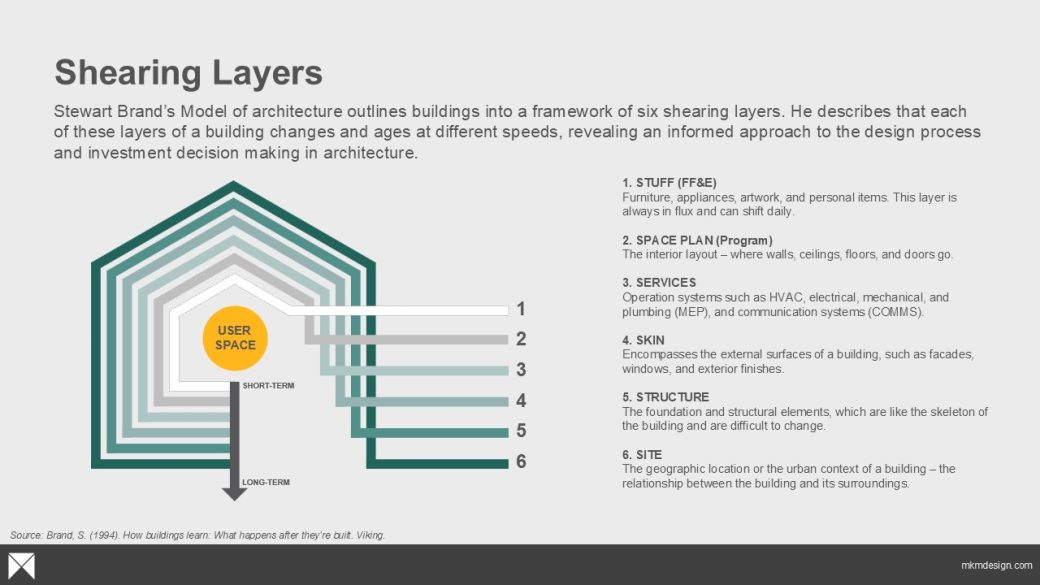
A building can be intentionally low-road through its faster-changing layers (i.e., stuff, space plan, and services), enabling people to rearrange furniture, adjust privacy measures, or adapt spaces for new activities. At the same time, it can be appropriately high-road in its slower layers (i.e., skin and structure), protecting structural integrity, building performance, safety, and long-term site relationships. This approach allows designers to invest in durable, maintainable infrastructure while making the elements closest to everyday users easy to access and modify.
Enabling Adaptation
Ultimately, these frameworks encourage designers to measure success beyond completion. A “good” building is not one that does not change. It’s one that changes gracefully, appropriately, and with participation from the people who occupy it. By considering the degree of adaptability a space should offer, both today and in the future, designers can intentionally create environments that remain responsive throughout their lives, serving the purposes they come to support.
A building stays alive only by the occupants who love and care for it.
References:
[1] Brand, Stewart. How Buildings Learn (New York: Penguin Books,1995).